
Mineralogy defines the route
Assay does not reveal whether gold is free, on grain boundaries or locked in sulphides. Carbonaceous matter and cyanide- or oxygen-consuming minerals also need to be identified.
These features determine liberation, concentration and pre-treatment requirements.
Grinding and flotation
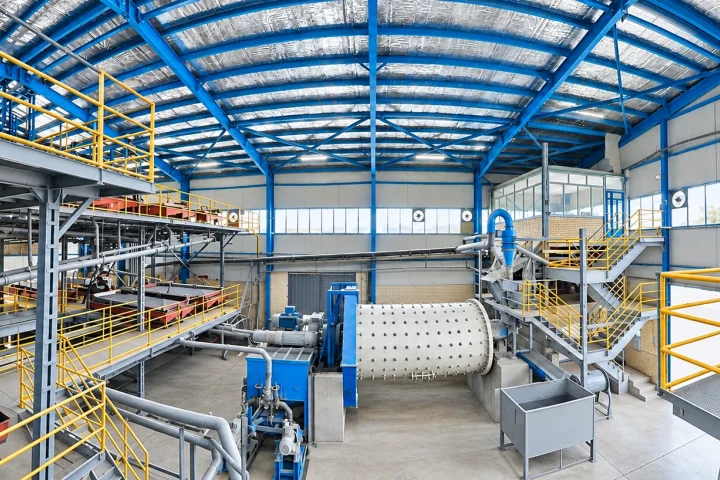
Flotation can concentrate gold-bearing sulphides into a smaller mass for downstream treatment. The grind must liberate value without excessive slimes.
Rougher, scavenger and cleaner design is governed by gold grade-recovery, not sulphide grade alone.
When pre-treatment is required
Pressure oxidation, bio-oxidation, roasting or ultrafine grinding may expose refractory gold. Selection depends on mineralogy, scale, energy, environmental performance and economics.
Alternatives should be compared on total recovery, consumables, tailings quality and operational complexity.
Cyanide leaching and recovery
pH, cyanide, dissolved oxygen, size, solids and time affect dissolution. CIL or CIP can then adsorb dissolved gold onto activated carbon for elution and electrowinning.
Testwork should report reagent use, carbon behavior, impurities and tailings—not recovery alone.
Cyanide management is part of process design
The International Cyanide Management Code covers production, transport, storage, use, worker safety, emergency response and management of solutions and tailings.
Monitoring, containment, training and emergency scenarios should be engineered before construction.
FAQ
Frequently asked questions
What is refractory gold?
Gold that responds poorly to conventional direct leaching, often because it is locked in sulphides or affected by carbonaceous or reactive minerals.
Is flotation always required before leaching?
No. It is useful when gold follows sulphides and a smaller concentrate can be treated economically.
What does the Cyanide Code cover?
Production, transport, storage, use, safety, emergency response, training, tailings and decommissioning.
REFERENCES
Technical sources
Sources are provided for further technical reading. Final engineering decisions require project-specific testwork.